
The North Dakota Department of Agriculture (NDDA) conducts annual pest surveys across the state to allow for early detection of invasive and exotic pests, to protect North Dakota's agricultural commodities and natural resources, and to support the phytosanitary certification requirements for the export of North Dakota products to domestic and international markets. These surveys are conducted through a variety of agreements, including partnerships with the USDA-APHIS-PPQ, the Cooperative Agricultural Pest Survey (CAPS) program, Plant Protection Act Section 7721 (PPA 7721) funding, and state-supported efforts with local cooperators and volunteers.
North Dakota is the nation's top producer of durum and spring wheat, harvesting over 6 million acres annually. This survey monitors wheat, durum, and barley fields across all 53 counties for exotic insects, nematodes, and other diseases of phytosanitary significance. Scouts deploy pheromone traps baited for Old World Bollworm (Helicoverpa armigera) in wheat fields, collect composite soil samples for nematode analysis, and conduct visual inspections for black stem rust, dwarf bunt, flag smut, cereal leaf beetle, and cucurbit beetle. Survey results support the export of small grains to Canada and other international markets. This survey is conducted in partnership with NDSU Extension Integrated Pest Management Program (IPM).
North Dakota harvested approximately 3.64 million acres of corn in 2024, valued at over $2 billion. This survey inspects approximately 100 corn fields across the top corn-producing counties in the state for diseases and insects of national and export concern, including late wilt of corn, Stewart's wilt, Philippine downy mildew, corn tar spot, bacterial leaf streak, and cucurbit beetle. Visual inspections begin at the R1 growth stage and continue through mid-August. This survey is conducted in partnership with NDSU Extension IPM.
Trees are a valuable but limited resource in North Dakota, with over 700,000 naturally forested acres, 55,000 miles of windbreaks, and extensive urban and rural forests. This survey uses Lindgren multi-funnel traps deployed at sites across the state to detect non-native wood borers and bark beetles. Target pests include emerald ash borer, European spruce bark beetle, large pine weevil, six-toothed bark beetle, oak ambrosia beetle, and others. Trap sites are selected based on proximity to industrial areas, rail yards, tourist sites, firewood pathways, ports of entry, and other high-risk locations. NDSU Entomology provides identification support.
Fraxinus (ash) is the most abundant tree species in North Dakota's forests, urban plantings, and rural windbreaks. The emerald ash borer (Agrilus planipennis) is a devastating invasive beetle that threatens all ash trees. Emerald ash borer (EAB) was first detected in North Dakota in La Moure County in 2024 and in Cass County in 2026.
Each summer NDDA staff, NDFS staff, and city cooperators deploy traps baited with lures in ash trees across the state. Traps are placed in parks, rest areas, campgrounds, city boulevards, and other high-risk locations. Early detection of new infestations is critical to protect North Dakota's ash trees, allow for a rapid response to new detections, and to help prevent the spread of EAB.
Report a Suspect Ash Tree - NDDA
Karnal bunt (Tilletia indica) is a fungal pathogen of wheat that was first found in the USA in 1996. It has never been detected in North Dakota. The NDDA collects samples annually to maintain our status as being free of Karnal bunt, facilitating export of wheat abroad. Wheat samples are collected at harvest from grain elevators across the state at a rate of approximately one four-pound sample per million bushels of production, following the National Karnal Bunt Survey Plan. Samples are shipped to the USDA-APHIS Karnal Bunt Project Laboratory in Phoenix, Arizona for analysis. The survey is conducted in half of the state every year. In odd years, the western half of the state is sampled. In even years, the eastern half of the is sampled.
The khapra beetle (Trogoderma granarium) is one of the world's most destructive stored grain pests and is not known to be established in the United States. Unfortunately, regular interceptions are made in cargo at ports of entry across the country. This survey targets high-risk facilities such as grain elevators, grain storage sites, and retail markets that sell imported goods. Wall-mounted traps and lures are placed at participating sites and screened for khapra beetle larvae. Survey results support the export of North Dakota grain to countries that regulate for this pest. This survey is conducted every other year.
North Dakota is the nation's leading exporter of seed potatoes to Canada and is an emerging supplier of potatoes to Mexico. This survey samples soil from seed potato fields to screen for pale cyst nematode (Globodera pallida) and golden nematode (Globodera rostochiensis), two federally regulated pests of phytosanitary importance. Soil samples are collected annually from priority fields, and samples are processed at the USDA-APHIS PCN Laboratory in Idaho Falls, Idaho. The survey is conducted in cooperation with the North Dakota State Seed Department.
This general survey aims to detect exotic nematodes across a variety of crops and nurseries statewide. Approximately 100 soil samples are collected annually from various crop fields and nurseries and sent to the University of Nebraska–Lincoln Nematology Laboratory for PCR analysis. Target nematodes include pale cyst nematode (Globodera pallida), golden nematode (Globodera rostochiensis), soybean cyst nematode (Heterodera glycines), sugarbeet cyst nematode (Heterodera schactii), chickpea cyst nematode (Heterodera ciceri), potato rot nematode (Ditlenchus destructor), British root-knot nematode (Melodogyne artiella), and others. Results support exports of soybeans, pulses, potatoes, and nursery stock to countries including Canada, India, Uruguay, Australia, Argentina, Mexico, and Cuba.
The Japanese beetle (Popillia japonica) is a highly destructive invasive insect that feeds on nearly 300 different plant species, including field crops, ornamental plants, turf, and trees. North Dakota has conducted Japanese beetle trapping since the early 1960s, and beetles have been detected annually since 2012. The survey deploys over 500 traps across the state each year relying on both NDDA staff and volunteer trappers. Since 2022, a significant population has become established within the city Grand Forks, ND.
PESTS OF CONCERN
EAB has been confirmed in North Dakota.
More about Emerald Ash Borer
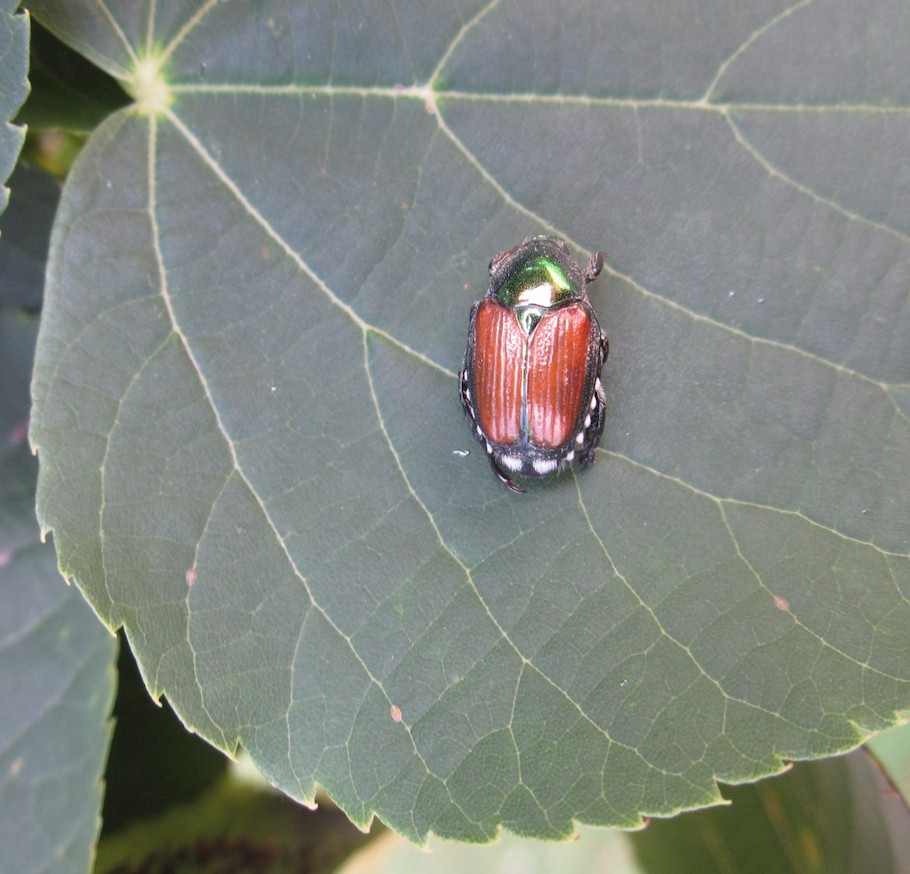
Japanese beetle (Popillia japonica) was first discovered in the United States in New Jersey in 1916. A native of Japan, the beetle occurs in all states east of the Mississippi River. Japanese beetles attack a broad range of host material including nearly 300 species of plants. The adult beetle will feed on field crops, ornamentals, trees, shrubs and garden plants, severely defoliating and skeletonizing the host plants. The larvae will feed on the roots of turf grasses and field crops (especially corn and soybeans) as well as organic matter in the soil, severely damaging golf courses, lawns and pastures. The Japanese beetle is a highly destructive plant pest that can be very difficult and expensive to control.
Japanese beetle adults are about ½ inch long with the male slightly smaller than the female. The insects are metallic green in color with bronze wing covers called elytra. Adults begin to emerge mid-June with peak emergence occurring approximately 3 to 4 weeks after initial emergence. The female beetle will burrow into the soil during the day to lay eggs, laying up to 60 eggs in her 2 month lifespan. Eggs will hatch in about two weeks. Larvae, which are about 1 inch long and cream colored with a brown head, will live in the soil, feeding on plant roots. The insect will overwinter as third instar larvae below the frost line and will pupate and emerge the following spring.
Related Resources
The spongy moth (Lymantria dispar) was brought to the U.S. in 1869 to experiment with silk production. Populations soon established and the pest has been expanding in distribution since. Adult females are not able to fly. Spongy moth larvae spin a thread of silk and disperse in the wind. It is estimated that this natural spread would be about 2 miles per year. The actual rate of spread has been much greater due to human aid, primarily by movement of nursery stock and automobiles.
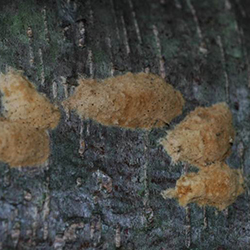 | 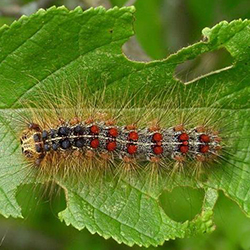 | 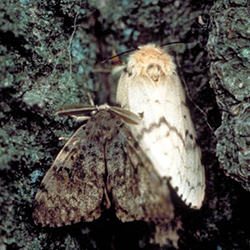 |
| Egg Masses:Pennsylvania Department of Conservation and Natural Resources - Forestry Archive | Larva: Bill McNee, Wisconsin Dept of Natural Resources | Adult male and female: John H. Ghent, USDA Forest Service |
Spongy moths are not known to occur in North Dakota. In the past several years, infestations have been found in the Twin Cities area of Minnesota, more recently large numbers of moths have been caught in the arrowhead region. Steps are being taken to slow spongy moth spread. Trees, Christmas trees, shrubs and logs from quarantined areas must be certified before movement. State and federal agencies use pheromone traps to detect outlying populations. Eradication measures are taken if outlying sites are determined to have established spongy moth populations. Since 1993, officials have implemented a “Slow the Spread” program that uses intensive sampling and precise population control techniques. The program is concentrated on a 100 mile wide band bordering the generally infested area. The rate of spread has been about half as fast since implementation of the program. This program has been implemented in the arrowhead region of Minnesota since 2003.
Spongy moths feed on a wide range of trees and shrubs and could be transported on any nursery stock or Christmas trees brought into the state from quarantined areas. Closely inspect and monitor stock received from these areas and ensure shipments are accompanied by a federal certificate or stamp demonstrating compliance.
ADDITIONAL INFORMATION
RESOURCES
Pest Survey Contacts
Scott Opatril
Plant Protection Specialist
Cell 701-226-4321
sopatril@nd.gov